
Network Architecture is the design of a computer or communication network that shows how devices, software, protocols, and media work together. It defines the physical and logical structure, task allocation, and connectivity between clients like laptops and servers. Simply put, it provides the rules and tools for smooth communication, managed by network architects.
Network Architect vs Network Administrator vs Network Engineer
- Network Administrator: They take care of a network that’s already set up. They handle day-to-day tasks like fixing problems, adding users, and making sure everything runs smoothly.
- Network Engineer: They’re like the builders and fixers. They create networks based on designs, make changes when needed, and troubleshoot any issues that pop up.
- Network Architect: They’re the big planners. They design how a network should look and work. They create the blueprint that the engineers follow to build the network
Types of Network Architecture
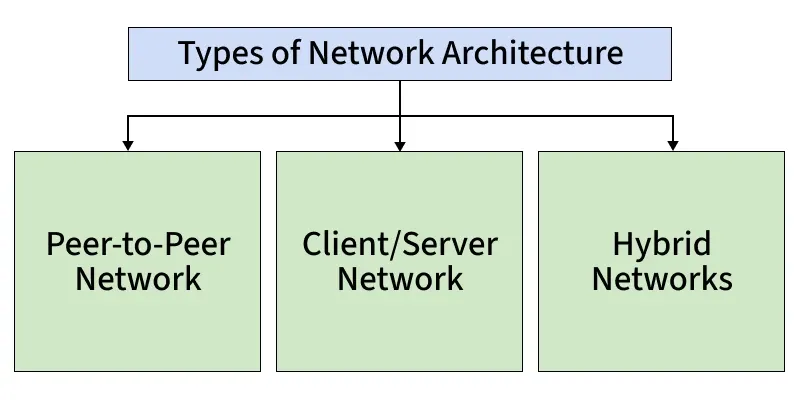
Computer networks can be classified based on architecture into two primary types:
- Peer-to-Peer Architecture
- Client/Server Architecture
- Hybrid Networks
1. Peer-to-Peer Architecture
In a P2P network, computers (peers) are directly connected, usually via the Internet, to share files and resources without a central server. Each computer acts as both client and server, with equal roles and responsibilities. Tasks are distributed across all devices, making P2P suitable for small setups (up to about 10 computers). Since there’s no strict client-server division, peers can both send and receive data directly. P2P networks are commonly used in business, education, and military applications.

Advantages of Peer-to-Peer Architecture
- P2P network is less costly and cheaper. It is affordable.
- P2P is very simple and not complex. This is because all computers that are connected in network communication in an efficient and well-mannered with each other.
- It is very easy and simple to set up and manage as installation and setup is less painless and computer manages itself. This is because of built-in support in modern operating systems.
Disadvantages of Peer-to-Peer Architecture
- It is more difficult to manage security policies consistently.
- Each peer demands individual care and control.
- As the network expands in size, it may become inefficient.
2. Client/Server Architecture
CSN (Client/Server Network) is type of computer network in which one of centralized and powerful computers (commonly called as server) is hub to which many of personal computers that are less powerful or workstations (commonly known as clients) are connected. It is type of system where clients are connected to server to just share or use resources. These servers are generally considered as heart of system. This type of network is more stable and scalable as compared to P2P network. In this architecture, system is generally decomposed into client and server processor or processes.

Advantages of Client/Server Architecture
- A special Network Operating System (NOS) is provided by server to provide resources to many users that request them.
- It is also very easy and simple to set up and manage data updates. This is because data is generally stored in centralized manner on server.
- The server usually controls resources and data security.
Disadvantages of Client/Server Architecture
- If the server fails, clients may lose access to services.
- Setting up servers requires a higher investment in hardware and software.
- Managing servers requires skilled personnel.